Friday, September 12, 2008

The integrated air defence system Australia had to have.

Australia enjoys a unique geographical position with perhaps the most strategic depth of any nation. However this tyranny of distance comes at a price. With an arc measuring over 6500 km’s of air and ocean that make up the sea-air gap to our north, calling the task of defending our northern approaches for a navy of twelve major surface combatants and six submarines challenging is perhaps somewhat of an understatement. Therefore the long range, firepower and speed of response that air power provides means the RAAF will always play the primary role in the defence of the sea-air gap. The RAAF’s ability to monitor, operate in and dominate the battle space to our north is and has been a cornerstone of the nations defence in the post world war era. Consequently in order to maintain the capability edge the RAAF has enjoyed over our neighbors in the last 6 decades a world class, integrated air defence system has been implemented by the ADF and should be fully operational by 2013.

An improved kill chain:

In order to implement the improvement in capability needed every link in the kill chain is either undergoing significant upgrade or new elements are being added to achieve a truly flexible and lethal air combat system.

Providing theatre wide ISR capability is the Jindalee Operational Radar Network (JORN) which has a range in excess of 3000km’s. JORN provides early warning capability throughout the sea-air gap and is capable of monitoring most aircraft (non-VLO) and practically all naval traffic throughout the northern approaches. The system works by refracting HF radio waves off the ionosphere to achieve ranges well beyond conventional radar limitations. The transmitter and receiver arrays are both located in central Australia over 1000km’s inland at Longreach Queensland and Laverton Western Australia. This distance from any threat does limit the systems vulnerability, with only a small number of global powers possessing the capability to effectively reach the systems vital components and none in our region. It appears the system does have some current limitations however; the resolution achieved by HF may not be high enough for weapons cueing, particularly when dealing with airborne threats. Therefore JORN can not effectively act as a targeting platform and is essentially a wide area surveillance asset.

JORN's sensor footprint


In order to provide target quality radar track data on air and sea targets the RAAF has ordered 6 E-737 Wedgetail Airborne Early Warning & Control (AEW&C) aircraft scheduled for initial operating capability (IOC) in 2010. Each of these world leading new platforms is equipped with Northrop Grumman’s revolutionary Multi-role Electronically Scanned Array (MESA) radar, which is in effect a large and extremely sophisticated AESA. Exact radar capabilities are classified but the MESA is reported to have an IFF (Identify Friend or Foe) range in excess of 500 kilometres and can track over 3000 targets. The L band MESA will be able to very precisely track small, high speed, low altitude targets such as Anti Ship Missiles in addition to allowing individual platforms to take ‘EM cold’ AIM-120 missile shots. Wedgetail will provide the ADF with a stand off targeting and surveillance capability that is highly mobile, extremely capable and precise. It is likely to be the nucleus of all future RAAF packages after its introduction.


E737 Wedgetail


The RAAF’s main air superiority asset, the F/A-18C/D HUG Hornet is likely to continue to see service until 2017. The Hornet fleet has undergone significant upgrades throughout its service with the RAAF and is now far more capable than when originally delivered. The inclusion of the AN/APG-73 radar, a fully glassed cockpit, Link 16, AN/ALR-67(V)3 Radar Warning Receiver (RWR) and a modernized weapons suite including the AIM-132 ASRAAM provides the RAAF with a very capable platform even considering the current and projected threat environment.
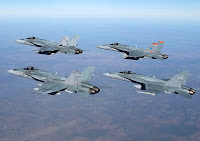
F/A-18C Hornet


With the announcement of the retirement of the F-111C~G fleet in 2010 and its replacement with the F/A-18F Block II the RAAF will receive its first new combat platform in over 20 years. The F/A-18F BII is a highly sophisticated multi role fighter that is based on a revised legacy Hornet airframe and is about 30% larger. Although visually the Super Hornet may seem similar to its predecessor the two only share only 10% commonality. The F/A-18F BII is equipped with a “5th generation” avionics suite lifted from failed X-32 JSF contender built around the AN/APG-79 AESA radar. This system is described by many as the most capable fighter sized radar operational anywhere, with extremely small side lobes, significantly greater detection and track radii than legacy radar’s, Low Probability of Intercept (LPI) search and track, improved resistance to Electronic Countermeasures (ECM), a latent electronic attack capability (EA) and near instantaneous scan rates. This in combination with the other advanced features of the avionics suite such as the world leading Human User Interface (HUI), fibre-optic data bus and digital AN/ALR-67 (V)3 RWR makes the F/A-18F BII an extremely capable strike asset and Beyond Visual Range (BVR) fighter.

F/A-18F Super Hornet


The addition of the F-35A to the RAAF’s order of battle in 2015 (under the current plans) will add LO to the significant capabilities the Super Hornet provides, in addition to an even more advanced HUI, Electro Optical (EO) and Electronic Warfare (EW) suite’s. The 5th generation F-35A is a quantum leap in capability as the first LO platform operated by the RAAF, and is at least half a generation ahead of any possible threat platform out to 2025.

The RAAF has operated nearly all of the AIM-120 AMRAAM derivatives, AIM-120B first integrated on the F/A-18C/D fleet in 2002. This BVR missile has been the cornerstone of western aligned air forces for the last decade and was the first air to air missile equipped with an active radar seeker and data link to see widespread use. The latest derivative of the AMRAAM series is the AIM-120D, which will reach IOC with the USAF and USN later this year. The AIM-120D is a significantly improved AMRAAM derivative, with a maximum engagement envelope of over 180 kilometres; which is some 50 kilometres more than the longest ranging missile in the SU-30’s inventory, the R-27 ER/EA Alamo Long Burn. The AIM-120D also provides a significantly advanced seeker with improved Electronic Counter-Counter Measures (ECCM), larger acquisition basket and the ability to engage a target more intelligently. A major capability the AIM-120D provides is an improved two way data link which allows the missile to actively communicate with the launch platform relaying target acquisition data and other information. An additional capability this data link provides is the AIM-120D can be updated directly from a 3rd party, such as another platform or AEW&C asset. Currently equipped with the AIM-120C5 variant, the RAAF is almost certain to acquire the AIM-120D as soon as it is made available for export.

AIM-120D


With the retirement of the F-111 fleet and its replacement with the Super Hornet every platform in the RAAF’s order of battle will be Link 16 compatible. This high speed, high capacity, “unjamable” data link can transmit at up to 115.2 kbps allowing platforms to exchange tactical information in near real time. At the package or squadron level, Link 16 provides every platform an AEW&C generated radar picture that in addition to achieving much higher detection & track radii, will provide LPI and better ECCM (significantly so when compared to the AN/APG-73). This technique will allow said platform to engage targets without using their own radars for target acquisition and illumination which is a considerable tactical advantage. At the theatre level, Link 16 allows decision makers in the battle space to see a wide variety of ISR sources such as a JORN generated radar picture or the contacts generated by a platform’s RWR. This information distribution network will provide the RAAF with a near complete picture of the battle space particularly when the quality of the sensors feeding it is considered.

The ground component to this information gathering and distribution network is being implemented under AIR 5333 Vigilare ground based air defence system. Vigilare is a significant upgrade to the existing Command, Control, Communications & Computer (C4) systems currently used by the ADF. The system will compile data from a variety of sources such as JORN and Wedgetail and present a manageable and user friendly air picture covering Australia’s area of interest. This will provide what is considered the holy grail of air command & control, a clear and comprehensive picture of the battle space. This C4ISR platform will enable command to manage the battle space in a far more efficient manner, allowing the full potential of the ADF’s sensor systems to be utilized.

The combination of a world class information gathering and distribution network and extremely capable people, missiles and platforms will provide the ADF with an integrated air combat system without peer in the region.

Tactical Implications

State on state conflict is a systems based event, therefore the implications of this vastly improved air defence system are extremely significant and wide, ranging from the tactical to the strategic. Perhaps the greatest advantage of an extensive information gathering and distribution network is the massive improvement in situational awareness, battle space management and command decision making. The amalgamation and presentation of information provided by theatre wide ISR platforms as capable as Wedgetail and JORN have an enormous force multiplier effect. JORN will allow interception of intruding strike packages at maximum range, allowing engagement outside the threat cruise missile envelope. This capability does to an extent replace the need for a high speed interceptor. The RAAF’s maritime strike capability is also vastly enhanced by this system; it allows accurate threat assessment of enemy fleet operations, the utilization of the most effective strike profiles and the system can even conduct some battle damage assessment, all from the Australian mainland. By utilising a clear air and sea picture through out the sea-air gap, the ADF can utilise limited assets to the full. Realistically conducting an offensive campaign in JORN dominated battle space is not an attractive proposition for any of the global powers and is arguably not even realistic for any regional power.

The effects of information dominance provided by such an information gathering and distribution network are not limited only to theatre wide decisions; on the package level having information superiority is a decisive advantage. The ability to achieve the positional advantage is vital in any BVR or WVR engagement, and fighting within your own sensor footprint is a good way to ensure your ability to do just that. By providing the pilot with precise tracks of targets well beyond their own radar capabilities and the threat’s, you enable them to take the positional advantage in a number of ways, such as taking a missile shot from outside the threat’s radar footprint or from a position of altitude or kinematical advantage. In effect you allow the package to always fight on its own terms, and even in a superior platform prosecuting an engagement from a position of significant disadvantage is likely to be your demise. If the target has been engaged from outside their radar footprint, and has no AEW&C support, it’s likely the first detection of a threat would occur when the missiles radar seeker started emitting, which is far too late.


NCW concept


The effect of information distribution between platforms also has a significant effect on the employment of BVR missiles. Currently all BVRAAM’s are not truly fire and forget weapons when being used at long range. Although the R-77, PL-12/SD-10, MICA and AIM-120 series all have an inertial navigation system that can guide the missile unaided, without constant updates from the launch platform at significant ranges the disparity between the projected position and actual target track drastically reduces the probability of a kill. Therefore the launch platform has to illuminate the target for much of the missiles flight which severely limits options to manoeuvre; this significantly increases the counter engagement threat. The combination of Wedgetail, Link-16 and AIM-120D will allow the launch platform to make 150km+ ranged missile shots without using its radar as the fire control device, reducing the chance of RWR/ESM detection to near zero, achieve positional advantage, and manoeuvre virtually as soon as the missile has left the rail. The platform that is not part of a similar information gathering and distribution network will be at a severe disadvantage; prosecuting an engagement on the enemy’s terms, against a target that is rapidly manoeuvring while their own manoeuvre options are severely limited, again if the enemy launch platform is detected at all.

With the addition of the F-35A to the RAAF’s order of battle a LO platform will be added to this already formidable air defence system. With a radar cross section of less than .001 M2, contemporary radar detection levels are reduced to tactically insignificant levels. Therefore the F-35A will be able to take AIM-120D missile shots directly in front of a threat platform within what would normally be its radar footprint. This also applies to threat AEW&C platforms, LO renders them practically useless severely limiting the capability of any competing information gathering and distribution networks.


F-35A Joint Strike Fighter


The decisive advantage integrated networks provide is obvious, and once in place ensuring the integrity of your network and disrupting the enemies becomes paramount. This dual task falls primarily under the dark art of Electronic Warfare. In addition to Electronic Intelligence (ELINT), EW can be roughly divided into two major elements; disrupting the enemy’s communications and sensor capability or ECM, and keeping your sensor performance and communications intact or ECCM. Both of these capabilities are being significantly upgraded under the current modernization program.

The AN/APG-79 has a significant ECM capability that is being developed by Raytheon under the USN’s spiral development program. The extremely precise beam control and frequency modulation combined with the radar’s power output mean it can act as a very effective jammer, and according to the USN is achieving extremely substantial EA effects at “tactically significant ranges”, which would imply comparable distances to a BVR missile engagement envelope. This EA capability is intended to degrade radar capability at stand off range and interrupt data links.


An/APG-79 AESA


Although still in early development the latent EA capability of the baseline F/A-18F BII is significant, and any future software upgrades developed to exploit it will surely migrate to the RAAF fleet. A comparable capability will be provided in the F-35A’s EW suite utilising its AN/APG-81 AESA radar. In addition to the EA capabilities of the baseline Super Hornet Block 2, there has been a notable level of interest in the dedicated EW variant, the EA-18G Growler. Fitted with the AN/ALQ-99 EW system the Growler can simultaneously produce EA effects on several different frequencies with a much higher power output and range. This variant was mentioned by the Defence Minister Fitzgibbon in a recent press release announcing the continuation of the F/A-18F acquisition indicating a significant level of interest from the Ministry of Defence. The extremely complicated LPI scan techniques used in 3rd gen AESA and MESA radars give them very effective ECCM capability, the sophisticated nature of their beam and frequency modulation make them very difficult to effectively jam. Additionally Link 16 has a very effective frequency hopping capability that provides significant resistance to active jamming. EW will always be an ever evolving battle between ECM and ECCM, and thanks to the depth of the strategic alliance with the US, the ADF will have access to their ongoing EW programs which are the most extensive and well funded worldwide.

In a rapidly evolving strategic environment the construction of a world class information gathering and distribution network as the foundation of lethal integrated air defence system is a key to the ADF’s ongoing military superiority in South East Asia. Once all of the elements are in place information dominance throughout the sea-air gap is virtually guarantied, and the RAAF’s lethality will improve accordingly. The ability to apply maximum combat capability at the appropriate point through a clear air picture, to take EM cold, AEW&C cued BVR missile shots from an advantageous position then rapidly egress or manoeuvre, and degrade enemy radar performance and disrupt communications will allow the ADF to dominate practically any engagement, regardless of individual platform capability or deficiency. This only partially illustrates the importance of the integrated system when evaluating aggregate capability, and the partial futility of platform centric analysis. The preservation of truly capable people, information dominance and organization wide improvement is the key to maintaining the RAAF’s capability edge, and it is a goal that we must constantly strive to achieve.

Thursday, September 11, 2008

Russian Carrier Doctrine in the 21st Century, the Strategic Conundrum

Past Mindset/Present Doctrine

Cold War


Throughout the last half of the 20th century the Soviet Union faced a simple and clearly defined, though extremely challenging set of strategic requirements. The major threat faced by the USSR in this period came from the western alliance NATO, and any conflict between the two would have centered on the primary theater in northern Germany. The prospect of a large combined arms campaign across western Germany and on to the English Channel was the predominant strategic challenge for both east and west, and just as in 1942 the western allies’ jugular lay across the Atlantic. Supplying NATO formations in the field during high intensity operations on such a scale would require huge amounts materiel from the continental United States, were the bulk of NATO’s industrial power lay. Therefore severing NATO’s jugular through interdiction of the Atlantic Sea Lines of Communication (SLOC) became the driving strategic focus of the Red Fleet, shaping its structure, operational & tactical doctrine, vessels, equipment, weapons and training. Consequently by the 1960’s the Red Fleet became a devastating tool of naval interdiction.

By the early 1980’s structurally the Red Fleet reflected the strategic requirements that drove its development; its two major strengths lay in tools of naval interdiction, the submarine arm and land based naval aviation, both of which were the most capable (and numerous) operational anywhere. The doctrine was simple, at the operational level the combination of conventional or nuclear submarine’s with long range, land based naval aviation directed by orbital & suborbital ISR (Intelligence, Surveillance & Reconnaissance) assets. On the tactical level, local saturation of the battle space at the critical point through application of overwhelming numbers of both platforms and weapons. At both the tactical and operational level, this doctrine could be, and historically has been devastatingly effective if applied correctly.


Left: A Tu-22M Backfire Right: A Tu-16 Badger
Clearly the most formidable tool the Soviet Navy possessed in this period was its maritime strike capability. Red Fleet naval aviation was built on the long range maritime strike platform and anti ship missile (AShM), the most capable of which is the Tu-22M Backfire. The infamous Backfire boasts a refueled combat radius of several thousand nautical miles, a top sprint speed of over Mach 2, a maximum payload of 3 supersonic AShM’s and a powerful surface search radar. Coupled with the long range, supersonic AShM like the AS-4 Kitchen the Backfire became a truly fearsome maritime strike platform. During this time frame the Northern Fleet maintained 3 regiments of Tu-22M’s on the Kola peninsular poised to strike south into the Atlantic SLOC.


Tu-22M equipped with the deadly AS-4 Kitchen.
The driving factor behind the development of the Tu-22M and Soviet carrier evolution was the USN’s introduction of an extremely capable fleet interceptor, the F-14A~C Tomcat. When the Tomcat appeared on the decks of the USN’s super-carriers the Red Fleets primary maritime strike asset of the past two decades, the Tu-16 Badger was virtually rendered obsolete. The long range interception ability, high speed and multi target engagement capability provided by the revolutionary AWG-9/AIM-54 Phoenix radar missile combination, in conjunction with E-2A~C gave the USN the ability to detect, track and engage Tu-16 strike packages well outside of the Badgers AShM engagement envelope. In order to counter the lethal threat of AEW controlled, AWG-9/AIM-54 equipped, long range interceptors, a platform that could fill the Tu-16’s role with comparable or better range/payload performance and a top sprint speed of Mach 2+ was clearly required. The primary alternative, the Tu-22B Blinder was originally designed in the 1950’s. The platform however proved to be an abject failure, with poor reliability and range/payload performance. It was only produced in small numbers. Consequently it never comprehensively replaced the Tu-16 in front line formations. The eventual answer to the changed threat matrix was the vastly improved Tu-22M.


Left: an F-14 carrying a 6x AIM-54 Phoenix load Right: A Tu-95 intercepted by an F-14

Soviet Carrier

The evolution of modern soviet carriers was like the rest of the Red Fleet shaped by the strategic landscape of the cold war. Unlike the classical western train of thought on the use and purpose of the aircraft carrier, primarily power projection, Soviet doctrine did not view the carrier as a means of offense on its own. This is clearly evident in the first generation of Soviet cold war aircraft carrier, the Kiev class Heavy Aviation Cruiser. Equipped primarily with ASW helicopters and only twelve Yak-38 STOVL fighters, the Kiev’s aviation component was more akin to the intended (pre Falkland’s) use of the Invincible class as ASW platforms with a limited fleet air defense component. Designed to be the centre of surface ASW groups, the Kiev class were far from true carriers. The Kiev’s primary firepower lay in its organic AShM load, which is typical of the primacy Soviet doctrine placed on this form of weapon.

A Kiev Class Heavy Aviation Cruiser

There was however a significant shift in doctrine during the 1970’s. Due to the increasing lethality of the USN’s fleet air defense and maritime strike capability, the first true Soviet carrier was designed and commissioned. The first of its class, the 65,000 tonne Admiral Kuznetsov was and is the only true, operational Soviet carrier ever built. Equipped with a ski jump and arrestor gear, Kuznetsov can operate conventional fighters using Short Take Off but Assisted Recovery (STOBAR) techniques. Embarking a squadron of 12~16 Su-33 Flanker D fighters the Red Fleet could for the first time project a credible fighter force into the North Atlantic and beyond.

Kuznetsov had two primary effects on the cold war naval balance. For the first time Soviet ASW surface groups operating in the western Barents Sea and Arctic Ocean could enjoy credible organic fighter cover, something that had been severely lacking previously. But perhaps more importantly, now the Red Fleet had the ability to put capable fighters deep into the North Atlantic, which could then provide land based maritime strike packages with fighter escort during the terminal phase of an engagement. This would have a dramatic effect when facing a USN carrier battle group or heavily escorted convoy. In addition to attempting to intercept an inbound strike package’s ingression at Mach 2, any F-14A~C would now have to contend with a counter engagement threat. An F-14 supporting several AIM-54 missile shots would have to maneuver if engaged by an R-27 equipped Su-33, which would in turn have a dramatic effect on the Phoenix shot’s probability of a kill (PK). Providing the Tu-22M with a fighter escort would not only increase the package’s survivability but lethality as well, allowing more missile’s to be launched before interception which is critical to Soviet doctrine of battle space saturation.


Left:The Admiral Kutznetsov Right:An Su-33 Flanker D
Obviously the Soviet carrier force was designed around a distinctly different doctrine to its western counterparts, intended from the outset to work closely with the Red Fleets primary strike asset; the land based supersonic strike aircraft. The Kiev’s and Kuznetsov clearly show the Atlantic/cold war centric strategic thinking that dominated every aspect of the Red Fleet, illustrated by the fact that Soviet carriers were only designed with true power projection as a far afterthought; Kuznetsov embarking only 5 strike capable platforms. In short the Soviet aircraft carrier was designed completely around a specific set of strategic requirements with only one potential foe in mind. For better or for worse, this is the carrier force and doctrine that the modern Russian navy has inherited.

The Strategic Conundrum

After the fall of the Soviet Union in the early 1990’s, like most of the Soviet military the Red Fleet fractured into several national formations distributed between the former Soviet Republics. The largest slice of this massive pie was left to the largest former Soviet Republic, the Russian Federation. However the modern Russian Navy is but a shell of the former Red Fleet. After widespread economic collapse and massive funding shortages during the 1990’s dozens of vessels and aircraft were decommissioned, scrapped or simply left to rust in port. The carrier force was not spared either, with all 4 Kiev class cruisers sold to the Peoples Republic of China (Currently Kiev is now an operating military theme park in the port of Tianjin China, Minsk is being fitted as a museum in China) , broken up (Novorossiyk), or undergoing re-fit in order to be sold to India (Admiral Gorshkov). The only operational carrier left in the Russian navy is the Admiral Kuznetosv. The same bleak story is repeated across the breadth of the Russian navy, with land based Naval Aviation and the Submarine Arm suffering terribly throughout this dark period.


Left:A Foxtrot class SSK rusting in a Russian naval base. Right:Kiev world military theme park, Tianjin
However, fueled by high global demand for energy, oil rich Russia has seen a remarkable economic resurgence of late, allowing a significant increase in funding for the whole Russian military. Notably this precipitated the resumption of Strategic Bomber patrols in 2007 and the first operational deployment of a carrier battle group to the Mediterranean for over a decade. These are small steps, but they are the first on the long road out of the dark days of the 90’s for the Russian navy.

The strategic terrain facing the Russia in 2008 is vastly different to what the Soviet Union faced in the 1970’s and 80’s. There is now no longer any major threat to mainland Russia and no realistic possibility of a war of national survival in the foreseeable future. Therefore the driving strategic focus of virtually every aspect of the Red Fleet, naval interdiction of the Atlantic SLOC, is now a moot point. Currently the Russian navy faces the conundrum of being equipped with an operational doctrine, structure, vessels, weapons and training, all heavily optimized for a set of strategic requirements that no longer exist. In more ways than one Russia stands at the strategic crossroads.

The Contemporary Strategic Landscape

The strategic challenges facing Russia in the early 21st century differ greatly from the last half of the 20th. Apart from the fact that any real (rather than perceived) threat from NATO is now gone Russia finds itself in a greatly different position to its Soviet ancestor. The overarching strategic goal is vastly different to the ideological struggle with the west that dominated the Russian/Soviet thinking during the cold war. The contemporary prize is not ideological supremacy over a dreaded enemy, but economic growth through tapping global markets. Therefore Russia’s mid term strategic goal has shifted to becoming a viable global alternative to the US as the guarantor of local security for smaller nations.

Becoming the guarantor of regional security does grant a level of political hegemony, but more importantly it secures economic ties and reduces impediments to trade. The economic rewards of regional hegemony are clearly evident in America’s position in the Middle East, which provides the US with both a significant source of foreign investment and a large portion of its energy requirements. This fundamentally different strategic landscape posses some interesting challenges to Russian decision makers in the mid term, which will have to change not only their military structure and posture, but the way they are viewed by both the wider global community and themselves.
20% of the US's crude oil imports are from hegemonic allies in the middle east.


Emergent Russia now faces a brand new set of strategic goals, however does not currently now have the tools, or more fundamentally the doctrine to achieve them. The Russian navy is still visibly the mired in the cold war, with what operational units it has left geared heavily toward naval interdiction. If Russia is to be successful in providing security to areas of the globe that stretch beyond its current sphere of influence then it must eventually turn to its navy as a tool of power projection, something the Soviet Union only contemplated but never truly achieved. Central to this question is the current and future carrier force and specifically what role it will play in Russia’s forthcoming global strategic posture and operational doctrine.


Strategic Air Power centric operational doctrine

Perhaps the smallest shift for Russia to undertake would be to peruse a Strategic Air Power centric operational doctrine, simply because the primary element remains the land based strike platform. Operating under the pretense of strategic air power being the primary tool of power projection beyond continental Europe and Asia is well suited to the current Russian operational doctrine, tactics, training and equipment. Russia’s strategic air power is arguably in better shape than the carrier force, with several regiments of Tu-95’s, Tu-22M’s and Tu-160’s currently operational and undertaking widespread training exercises. Russia’s strategic air arm is still extremely potent, coupled with its formidable cruise missile capability it gives decision makers in the Kremlin a viable method of projecting power well beyond its borders. This seems to be the path being perused at the moment with the continued (although limited) production of the Tu-160 Blackjack and development of new stand off missile’s such as the KH-101 and KH-555.


Left:A KH-555 loaded on a Tu-95 Right:A Tu-160 launching a KH-55S Kent
However strategic air power faces a similar challenge to what soviet naval aviation faced in the 70’s and 80’s; operating at extended range against a target that may have organic fighter cover. This problem is exacerbated due to the particulars of attacking land based targets as opposed to ships in blue water. The major difference is the fact that land based targets usually enjoy a level of geographical depth. Even if your strike platform is equipped with a 300nm range standoff weapon, if the target lays 200nm inland the strike package will have to come within 100nm of going “feet dry” to reach weapons release point. Therefore the strikers will have to enter the targets fighter engagement footprint in order to employ weapons effectively. Utilizing high speed ingression and organic EWSP suites it is most likely that the strike packages would still hit their targets when facing a lesser power; however the losses may be unacceptably high considering the cost and time to manufacture a single Tu-160. Additionally the survivability of a Tu-95 when facing even a limited fighter threat may not be acceptable, significantly limiting the number of available platforms. Clearly if the Russians were facing a reasonably well equipped foe the strike packages would require fighter escort while entering the targets fighter engagement footprint.

The value of strategic strike platforms is such that even a moderate risk of loss to the targets air defense system may be enough to deter the Kremlin from taking assertive action if its direct interests or security are not threatened. However if the Russian navy could provide the strike packages with a fighter escort the risk of interception would be significantly reduced. If a Carrier battle group could be deployed to the theater, it would not need a significant amount of organic strike capability, the punching power would be delivered by the land based strike platform. Current Russian carrier doctrine and equipment is well suited to this posture. If such a scenario were to play out in 2009 and the assets were deployable, Kuznetsov deployed to theater with 16 Su-33’s could provide strategic aviation with credible fighter cover, allowing the Kremlin to apply devastating power against a much larger range of possible adversaries. This doctrinal change is cheap, effective and more to the point does not stray far from the pervasive soviet operational doctrine which preceded it.


Left:A Tu-160 escorted by a Su-27 Flanker. Right:A vulnerable Tu-95 intercepted by a Typhoon off the UK .


Aircraft Carrier centric operational doctrine

The other possible option is the pursuit of an operational doctrine and that is centered on the Carrier as the primary tool of power projection. This is the doctrine employed by the world’s greatest naval power, the United States Navy. In engagements that range from Leyte Gulf to the Operation Rolling Thunder to Operation Allied Force, the utility of the carrier as a tool of power projection has been clearly illustrated. The ability to move credible air power into the theater and sustain it there regardless of air field availability is a capability that only the carrier can provide, and the effect of a single carrier deployment to a region is greater than perhaps any other single asset. Truly the potential of a carrier to change the posture and intentions of a lesser power is profound.


Unlike the major western carrier operators (the USN and France) Russia’s carriers are poorly equipped to be used in this manner. As stated previously the air-group Kuznetsov is currently capable of embarking is heavily geared towards fleet air defense and bomber escort. However the Kuznetsov has reasonable potential as a tool of power projection, the main element needing reform is the air group. If the aging Su-33’s are upgraded to Su-30MK standard, or replaced with MiG-29K’s or the newest navalized Flanker the Su-27KUB the Russian navy will have taken a major step foreword. However this will take significant expenditure as frontline fighters are not cheap, and in the short term upgrading existing strategic air power with better standoff weapons is a cheaper and easier path to take.


Left:A MiG 29K
Right:A relative of the Flanker Family, the multi-role Su-30
The critical decisions will be in the mid term. As Kuznetsov reaches the end of its operational life, the type and nature of its replacements will define Russia’s 21st century power projection doctrine. If the replacement carriers are equipped and armed in much the same manner as Kuznetov then Russian strategic thinking will be evident; the primacy of strategic air power will remain. However if the new breed of carriers are equipped with truly multi-role fighters, and there is significant investment in the fleet logistical train to sustain deployed air groups throughout an offensive air campaign then obviously Russia will have moved to a stance similar to the major western powers.

Conclusions

The strategic geography of the 21st century is still taking shape and, in many ways is more dynamic now than it has been in the past 100 years. The emergence of new powers and new markets illustrates the clear departure from the strategic paradigm of the cold war, with contemporary strategic rivals usually also close trading partners (such as PROC & the US). In this dynamic new strategic environment the battle will no longer lay along ideological fault lines but in economic areas of interest. Therefore whatever decisions are made by the Kremlin on Russia’s future global structure and posture, clearly the current status quo can not meet the requirements of the contemporary strategic environment.

Both options have their advantages, however clearly strategic air power can never replace the utility, sustainability, firepower and psychological impact of true carrier capability. Relying on strategic air power as your primary tool has significant limitations. For Russia to achieve global presence, which is clearly the mid term goal she must enjoy truly global reach, and due to the limitations of land based air power without a global basing infrastructure it is not something that can be achieved. Without airborne refueling Russian strategic aviation is limited by range/payload constraints, which in real terms restricts combat range (with a useful payload) to the north Atlantic/Pacific, Europe, North Asia and North America. Currently it only provides Russia with regional/continental reach, far short of the truly global capability required to truly be an alternative to the US as the provider of regional security. Nevertheless Strategic Air Power offers a cheap, readymade capability that with a relatively small capital outlay can be effective in a short time-frame. It seems to be the path undertaken by the Russians in the short term.
The ill fated Soviet Ulyanovsk supercarrier, a true tool of power porjection.


Clearly post 2020 the most effective option for the Russian navy is a combination of land and naval aviation used in conjunction to achieve global strategic results. Recently the Kremlin announced plans for the construction of 5~6 aircraft carriers in the 2020+ timeframe. Obviously the achievability of this number has to be questioned, unless a small (<20kt)>
STOVL design is adopted. Perhaps a more realistic goal would be construction of three, 40,000T carriers with a comparable design to Kuznetov. For all its shortcomings in payload constraints and package generation capability, the technological simplicity of STOVL (and the complexity of steam catapults) lends it self well to the new, lean Russian navy. A sustainable number of carriers supported by land based aviation with an increasing global basing infrastructure will provide Russia with the capability it needs to achieve its strategic aims. Both the flexibility and sustainability of carrier based aviation means that only it can achieve the global reach Russia requires, however it remains to be seen whether the Kremlin has the fortitude or vision to realize that fact.


Thursday, November 15, 2007

Four Corners, Flying Blind indeed

On the 29'th of October this year the ABC current affairs programme Four Corners aired an episode named "Flying Blind" which addressed Australia's recent decision to purchase the F/A-18F super hornet as a replacement for the RAAF's ageing F-111C/G fleet. The ratio of "critics" to "defenders" seems to havebeen stacked in favor of the negative camp at the number of 5 to, um none (not including the three lines an RAAF pilot was afforded), which pretty clearly shows the programmes intent. It was basically a hatchet job. Accordingly there was a distinct lack of objectivity in the analysis presented, which seems to be a common theme on both "sides" of this debate, so i will try to provide some. The programme, and the discussion that has followed on other defence blogs and forums, centered around three major points; that the F-111 did not need to be retired and could/should be retained until the introduction of the F-35A , that the F/A-18F is incapable of replacing the F-111 in the strike role, and that the F-15E should have been procured instead, I will address these points in turn.


F-111's wrongful retirement.

The F-111 Aardvark, or "pig" as it is affectionately known, was introduced into the RAAF ORBAT in June 1973 after a much belated decade long wait, and have now been in service for 35 odd years. One of the primary reasons for the decision to retire the "pig", in addition to the fear of an availability and capability gap arising post 2010, was a wing stress test conducted by the DSTO which indicated that under certain, high stress conditions the wings would be prone to failure. This is of utmost importance for the F-111, which fly's most of its strike profiles at high speed and low altitude (-50 meter) altitude, which puts huge stress on the airframe. Understandably the notion of the wings falling off while scooting along at 600 knots scraping the tree tops was not a palatable one for the DoD or DefMin. However a claim was made on 4 Corners by Air Vice Marshal Criss (ret) that an unnamed person had informed him that the test had been conducted by the DSTO under incorrect parameters. This has been lauded by the "pro F-111" camp as evidence that the pig has been retired under false pretences. Now whether or not this claim is indeed true, and there has been no conclusive evidence of such apart from hearsay, that does not change the fundamental problem with the pig. It is not simply a question of a single flaw in the platform which renders it unsafe or incapable, looking at the problem in such a simple context does not do the RAAF or the Australian public justice in my opinion.

an F-111C at low altitude


The retirement of the pig needs to be looked at from a cost to benifit analysis perspective, which is not the view portrayed 4 corners. It was stated by Wing Comander (ret) Chriss Mills that the F-111 could be kept in the air "virtually forever" due to the availability of spares in USAF boneyards. While this technically may be the case it is in reality a moot point. We could keep spitfires flying "virtually forever" if we decided too, and even if there wasnt abundent spare parts we could conceavably manufacture what we needed. Anyway there is also a problem with a lack of spare parts with the rocket ejection system, and the current stocks will decay in the 2010~2012 timeframe. If there is a catostrophic accident after that time the crew will not be able to bail out. Now again we can make the stuff if we realy wanted to, but as an esteemed member of the defence community eloquently put it "Its not weather you can make a replacement widget, its wether the cost/benefit analysis, public interest, platform investment and risk analysis all make sense". As is invairiably the case with airframes the older the platform the higher the maintinance costs, the lower the mean time between failure rates and higher maintinance manhours per flight hour. The F-111 fleet is therefore becoming more expensive to run by the day and it is becoming harder to maintain adequate numbers of operational aircraft. This is the same problem the USN faced with the F-14D Tomcat. That platform arguably offered much more capability in contemporary terms than the F-111, however it was retired (much to the discust of 'cat lovers) due to the masive maintinance costs, in both manhour's per flight hour and cold hard cash. At the end of its career the F-14D needed a stagerring 40 maintinance man hours per flight hour just to keep the platform operational. If we intend to keep the F-111 flying "forever" or post 2010 the RAAF will be looking at a similar picture. So is the much vaunted "strategic deturrence" and jaw droping capability of the pig worth the ever growing maintinance, availability and monetary costs? Well unfortunatly in the 21st century threat environment, the F-111 just does not deliver the same capability it did in the 1970's.


F-14D, 40 maintanence man-hours per flight hour has a drastic effect on availability rates


F-111 vs F/A-18F

On papaer alone the F111 is a better strike platform. Longer range, heavier payload, higher flat out sprint speed (it still holds the record of the fastest platfrom in the region, just) and plain sex apeal all go to the pig. Its almost like the platform that all by itself elevates Australia to a major power. Well it may have 25 years ago, but the sad truth is in the current threat environment it has LESS range, LESS usable payload and its speed no longer holds the tactical significance it used to (Still has the sex apeal though). Under current RAAF operational doctorine an F-111 can not conduct a strike mission in a theater were there is any air threat without an F/A 18C escort, simply because the pig is not survivable in the modern threat environment. The F-111's forte is high speed low altitude penitration which it achieves by utilising terrain following radar, which was state of the art in the 1970's. However in the face of an SU 30 air threat, equiped with the BARS PESA radar system & R77 missile, flying low and relatively fast (the pig can not fly super-sonic while at low altitude while the Flanker can hit Mach 2 higher up) will not allow you to avoid being shot down in droves. Modern radar/missile combinations can easilly handle a low flying aircraft, moveing at high, sub-sonic speeds which has a radar cross section the size of a barn. Sending in F-111's alone against any of the regional air forces would be a suicide mission. In the modern battlespace unless you have a comprehensive VLO strike platform like the B-2 or F-117, local air superiority needs to be established for conventional strike platforms (aka the pig) to effecteivly operate in the battlespace. Hence the change in doctrine. Therefore the in real terms F-111's range is useless because it is tied to the escort platforms. For the last 7+ years, our strike range has been limited to the refuled range of our legacy hornet fleet. The reality of the RAAF's situation is the F/A-18C/D HUG hornet is our most potent strike platform, considering its ability to employ J sersies PGMS (JDAM, JDAM-ER) and the Lightning IR targeting pod. The F/A 18F on the other hand can "self escort" effectively. The same (single) platform can establish local air superiority, strike high value well defended targets at stand off ranges, do an accurate battle damage assesment at stand off range, all at further range than a F-111/F-18C package (because F/A 18F has a much larger range than legacy hornets), in addition to being much more survivable than the F-111. It can even act as a taker for other super bugs. As you can see a platforms performance on paper means nothing without considering how it can be used in a realistic environment, and sadly the F-111 is a shadow of the long range striker most of us have loved for the last 3 decades.

left: an F/A-18C, F-111C package
right: an F/A-18D equiped with JDAM-ER

But what about the huge payload advantage i hear you ask? Again reality is somewhat diferent from the comparison on paper. The F-111 can lift and carry some 14300kg of payload in comparison to 8050kg for the F/A-18F, which is pretty impressive. However its realistic payload in an actual strike configuration is not so jaw droping. The F-111 has 5 weapon hardpoints (a spot were you can hang a weapon off the aircraft), one in the weapons bay on the belly and 2 on each wing. When carrying the pigs primary weapon, the Paveway II laser guided bomb, the belly hardpoint is taken by the Pave Tack pod which is needed to identify and lase targets for the LGB's, the outer two wing harpoints are taken by a single AIM 9M self defence missile and a Jamming pod. This leaves the two inboard weapons stations for the Paveways, which are usually 2000lb LGB's. Just two weapons, hardly jaw dropping is it? Even if the F-111 was using its most sophistocated weapon, the 1990's vintage AGM 142 Popeye stand off missile, it would still need a AIM 9M and jamming pod, allowing 3 at most, there is a similar story for the Harpoon anti-ship missile. This load of 2/3 weapons with no BVRAAM capability is juxtaposed to the 11 available hardpoints on the F/A-18F. A strike configuration for a super bug would see two AIM 9X WVRAAM's on the wingtips, an ATFLIR (Advanced Targeting Forward Looking Infra Red) pod on one sholder with an AMRAAM on the other, external fuel on the belly and inbound hardpoints (the USN does not use a fuel tank on the same side as the ATFLIR because of the obstructed view but it is unclear as to wether the RAAF will do the same, legacy hornets do use an inboard fuel tank). This leaves 4 hardpoints for a combination of strike weapons, either 4 larger Paveways, JDAM's, JSOW's or Harpoons, or smaller 500lb weapons on double racks. Therefore in real terms super bug brings more weapons to the fight and can strike more targets. In adition to the super bugs payload advantage, it uses much more sophistocated and capable weapons systems. The pigs primary weapons are the Paveway/Pave Tack laser guided bomb combination, the AGM 142 'popeye' stand off weapon and the Harpoon anti ship missile. The super hornet uses paveway and harpoon (although ATFLIR is much more sophistocated, smaller and capable than Pave Tack which was developed in the 1970's), it uses the J series PGM's which are a generation better than anything the pig offeres. The JDAM (Joint Direct Attack Mnition) free fall weapon is a GPS/INS guided weapon whcih has all weather fire and forget capability, with similar accuracy to the paveway series. JSOW (Joint Stand Off Weapon) is a GPS/INS guided glide bomb that offeres the same all weather, fire and forget capability, with extended stand off range and low RCS. Allthough not currently in the RAAF's plans, there is a possibility of JASSM (Joint Air to Surface Stand-off Missile, which is being purchased for the RAAF's legacy hornet and F35 fleet, assuming the missile is compleated) being intergrated onto the F/A-18F. This weapon has 370km+ range, a passive anti shipping capability and very low RCS. These weapons give the super bug a high altitude, stand off, all weather, fire and forget capability which the F-111 can not match.


left: F111C with Pave Tack pod
right: F/A-18F's weapons package

In simple terms the F/A 18F can strike at further range, with more weapons that are more capable than the F-111's, with a much better EWSP suite, and ISR capabilities thanks to the SAR (Synthetic Apature Radar) capabilities of the APG 79 radar. In real terms F/A-18F is a better strike platform. Additionally, the Rhino (super bug) provides us with a world class 4.5th gen air superiority fighter that is significantly more capable than our F/A-18C/D HUG fleet. One has to wonder as to the wisdom of a small to medium sized air force investing in a specialized platform that constitutes a quater of the RAAF's order of battle (ORBAT), which due to the limitations of size is usually the rhelm of large (10+ squadrons) air forces. Multi-role platforms in effect give the RAAF 4 squadrons of air superiority fighters and 4 squadrons of strikers.


Left: ATFLIR pod (left sholder) on an F/A-18C

Right: An AGM-154 C JSOW vertical attack

So why dont we just upgrade the F-111? Well in order for it to be worth it we would need to upgrade the pig to a point were it could self escort (that means BVR missile capability), lower its RCS and IR signature and upgrade its avionics so it can accomidate the latest weapons systems. Basically the aircraft would have to be striped to the bone and a new one rebuilt on its skeliton. Dr Carlo Kopp made such a proposal to the RAAF (which was flatley rejected). It inlcuded, replacing the current radar with the APG 80 (from the F-16E/F), replacing the whole avionics suite with the super hornet's, replace the engines with the F119's from the F22, replace the skin with the Radar Absorbant Material from the F35A, install the IR supression system from the F35 and the engine nozell. Such a drastic upgrade is needed because anything less would be a waste of time. Quite simply this is a bad idea on so many levels i'm not sure were to start. Assuming the US would allow all of these technologies to be purchased, which is doubtfull considering the F-22A export ban, we would effectively be manufacturing a new, orphan, platform. Such an undertaking would incur huge monetary costs (I dont care what APA says about it), and massive completion and budgetary risks for the RAAF and the taxpayer. A much smaller and simpler project has been atempted on the navies seasprite helicopters, were a new avionics and weapons suite has been partially installed in an old airframe. The project is 8+ years late and $500m over budget, and that is practically an order of magnitude LESS complicated and risky than such a huge upgrade of the F-111. And what would we recieve for the massive cost and massive risk to a 1/4 of the RAAF's ORBAT, a longer ranged, supercruising F-111 (which would not change much tactically) with anh RCS the size of a house (instead of a barn), that could to an extent self escort (any AIM 120 carriage would compromise the strike payload), but would still not be able to go toe to toe with an Su-30, which a super bug can. Remember that cost/benifit and risk analysis? If we took this path we would likely have the pigs in the shop for a decade, spending billions, and then end up with a platform thats capabilities are borderline obsolete when compared to the F35. Does that make sense?


F/A-18F Block II vs F-15E Block II

Lets face it, the F-15E Strike Eagle Bk II is a remarkable aircraft and a formidable platform, and like the F-111C paper comparison the Eagle apears to be far better. It can fly further, carry more weight of weapons, self escort, is AESA equiped, has a higher sprint speed and has superior super sonic maneuverability (and has that sex apeal). So why didnt we follow Singapore and South Korea's lead and buy the eagle? To examine the purchase properly, a comprehensive comparison or realistic use and capability is needed, in adition to cost, maintinance requirements, weapons package and risk. In raw performance eagle is a better on paper performer. In combat configuration with AAM's and 4 PGM's, F-15E enjoys a 16% range advantage over the super bug, which equates to 1270km's to 1095km's. Although this is an advantage, in a realistic strike profile both would be equally reliant on AAR (Air to Air Refueling) assets, and due to the nature of a combat strike profiles (the platform would not fly in a streight line and may fly at various altitudes and bearings relative to the target) an extra 200km's may not be as usefull as it sounds, although it is a definite advantage. This range advantage is offset to a degree by the drouge and shoot refuleing system used by the Super Bug, which is more efficent than the boom system used by the Strike Eagle, simply because two platforms can be refuled at once. In terms of payload, an F-15E can indeed put more bombs on target. If carrying a Mk 82 500lb JDAM load, it can carry 12 such weapons in adition to 4 AAM's, which is much more than the 6~8 500lb JDAM's the super bug can cary with a similar AAM & fuel load. However the only time such a load would be carried, and the only time a single platform would need to strike 12 or even more than 4 targets at a time is during a CAS (close air support) mission. However the F/A-18F can carry a lager missile load, with 10~12 AAM's being possible, compared to 8 on the Eagle. The mission the F/A-18F~F-15E is being purchased to fulfill is a regional strategic strike capability curently held by the F-111C which would require a combat load of ~4 PGM's, which both can achieve with external fuel and a sufficient AIM 120D load. They both fulfill this capability better than the F-111C, and can put sufficient stand off PGM's on target at the range required. Kinematically the F-15E is a significantly better performer, with a higher top sprint speed and better thrust to weight ratio. Aerodynamically its a split desision, the F-15E has a lower wing loading (which dictates your turn radius) and is a better performer in the super-sonic and trans-sonic flight regime, however at low speeds, due to the super bugs wing sweep and leading edge wing extentions, the F/A-18F is a much better performer. This is also the case for the very high alfa (angle of attack) performence envilope.


left: F-15E with a JDAM load

Right: an F/A-18E with a Paveway II/Maveric load, note the ATFLIR pod on the left sholder.

It is clear that in raw performance terms the eagle is a better performer, but as discussed in a previous post, the defining factor in BVR combat and SAM survivability is the avionics package. The extraordinary capabilities of the AN/APG 79 radar system have been discussed earlier, however in comparison with the F-15E Bk II this is actually not a real advantage. Part of the package offered to Singapore with its F-15SG purchace was the AN/APG 63(v)3 AESA radar system. The APG 63(v)3 is an entirely new radar system (apposed to the APG 63(v)2 which is simply an AESA antenna on the APG 63(v)1) which Beoing has evolved to a similar state as the APG 79, incorporating its advanced features and modes. The two systmes are comperable in most aspects, so for most the most part the only advantage the F/A-18F holds in terms of detection and track radii, is it LO charecteristics. By no means is F/A-18F a stealth platform, although it has significant LO features that drastically reduce its frontal RCS. It has been claimed to be between 1m2 and .1m2 which is a signifant adavntage over the F-15E Bk II or SU 30. Many F/A-18E/F critics point out that the fact that the super bug carries all of its weapons and external fuel (funnily enough) externally means this advantage is wasted. While this view holds some merit, external weapons mean that only a partial RCS reduction is possible, it still means the super bug will be detected and tracked later, which effectes the who see's who first question (aka, first look, first shot, first kill). The EW suite is comperable, both having fully digital RWR's (the Super Bugs ALR 67(v)4 bieng integrated on all of the RAAF's legacy Hornet fleet improving commonality) with a similar EA capability provided by the AESA radar. The real avionics advantage the F/A-18F holds over F-15E is its fiber-optic data bus, open architecture design allowing COTS (Commercial Off The Shelf) prosessing improvements and a "5th generation" combat management system and human interface (which benifited from Boeings work on the JSF programme with the X32). The effect of these 5th generation capabilities combined with the APG 79 and comprehencive EW suite gives the super bug a real advantage over F-15E specifically in the ability to employ these systems and information distribution, even though the AESA radar and EW suite are comperable. They are effectively "force multpliers" for the information gathering and distribution sub-systems and the offencive EW suite, allowing the pilot and RIO/WSO to more effectively employ these capailities and make better tactical desisions.

above: a super bugs coackpit


So from a pure capability standpoint, they are pretty evenly matched contenders, with Strike Eagle holding a small advantage in realistic raw performance (i.e. ability to actually employ performance advantages in real strike profiles) and F/A-18F holding a small advantage in avionics capability. However this is only a small element of decision the making process. The government must balance capability with risk, ease of integration, availability, maintenance considerations and above all cost. From this perspective it is easy to see why F/A-18F was chosen over the F-15E. The F/A-18F Bk II provides 95% of the capability (considering realistic operational configurations and the super bugs comprehensive avionics package) at 60~70% of the acquisition cost (recent acquisition costs for F/A-18E $78.4m, F-15E $108.2m, although the actual price would increase or decrease with the particulars of the agreement), lower maintenace requirements in both manhours and cash, 10% commonality with the RAAF's legacy hornet fleet, a complete weapons package (AGM-84 would have to be integrated on the Strike Eagle at the taxpayers expense adding to the cost and risk) and operating an identicle platform to the USN which allows us to plug into any block upgrade's and utilize the world wide logistics structure in place (F-15AU would be in some respects a unique platform, complicating logistics and maintenance requirements). As for the F/A-18F Bk II not being competitive when facing evolved SU-30 variants, refer to the previous article. In simple terms super bug offers ample capability at significantly less cost, less trouble, less risk with easier maintince and logistics considerations. From a cost/benifit analysis viewpoint F/A-18F is the far superior platform. It may not be the sexiest choice, but it is definatly the smart choice.


A few loose ends...

I just thought I'd address a few points of fact, implications or analysis presented in the programme that I thought was factually wrong, misleading or just plain stupid. This is a statement mad by Wing Commaneder Chriss Mills when refering to the SU-30 "It's a formidable weapon, it can fly higher, faster,.... its got better weapons". In a point of fact that statement is simply false. The Su-30's weapons package is distinctly inferior to the Super Hornet's, in fact even our legacy hornet fleet. The Flankers strike weapons are a generation behind the Hornets, relying on the KAB 500/1500L family of laser guided bombs, KH 29 "Kedge" laser guided missile and KH 59 TV guided missile. All of these systems are of the same technological generation as the F-111C's Paveway/Pave Tack combination. They are simply outclassed by the J series PGM's utilized by the hornet family, which provide an unmatched all weather, fire and forget stand off capability. The only strike weapon used by the Flanker which is even competitive is the KH 31 Krypton anti-ship/anti-radiation missile, with over 100km maximum range, it is a very capable ARM. Its range and kinematics are slightly better than the AGM 88 HARM anti radiation missile although is apparently less capable in terms of ECCM. As for the air to air stuff the situation is the same. The Flankers WVR missile is the R73, which is outclassed kinematically, aerodynamically, in seeker performance, off-broadsight capability, range and IRCCM by the AIM 9X which was specifically designed to outperform the R73. The primary BVRAAM is the R77, which again is completely outclassed by the AIM 120D. AIM 120D is a better performer in terms of range (>180km compared to >90km), ECCM, has a more capable 2 way datalink and better seeker performance. As you can see Super Hornet clearly has a superior weapons package.


left: KH 31 "Krypton" ARH
right: the much troubled but very capable and stealthy AGM 158 Joint Air to Surface Stand-off Missile (JASSM)

Four Corners "asked" Air Vise Marshal Criss and Wing Commander Mills to do a "hypothetical" simulation of an air strike on Indonesia by a squadron of F/A-18F's in 2012. i can say without hyperbole that this was one of the most ridiculous and unrealistic simulations i have ever seen. Where was JORN or Wedgetail and the information dominance these systems provide? Who in their right mind would use strike profiles designed for a pig, i.e. a low and fast sprint to get to weapons release point when you have a HUGE EW advantage to exploit? There was only one outcome that was going to come out of that "hypothetical" but thank god these men are no longer in running strike missions for the RAAF. Lets look at a more realistic scenario with similar assets: 16 SU 30's are on CAP (combat air patrol) above Java in 4 packets of 4. All of these platforms are tracked by JORN as soon as they took off. A squadron sized package of 16 Super Bug's takes off from RAAF Tindell or RAAF Learmouth for their targets, 4 with a mixed JSOW AAW load and 8 with a full AAW load. They are preceded by a Wedgetail AEW&C aircraft (escorted) and 2 A330 tankers. The Wedgetail sets up shop several hundred kilometers out into the Indian ocean, its radar footprint extending throughout the battlespace, which remains undetected due to the MESA's LPI capability (and the fact that it remains outside of the Flankers/ground based radars detection radii). The 8 AAW equipped super bugs move towards their individual flanker flights as they turn to the north in their orbits, allowing them to stay out of the flankers radar footprint. The pairs of Super Bug's make super sonic runs toward their targets while staying emissions cold, all target information being provided by the Wedgetail via Link 16. When the Bugs reach ~150km from the Flankers they launch missiles, 2 at each Flanker, still emitions cold. At this point the Indonesians may still be unaware they are even being attacked, while there are missiles in the air. As the AMRAAM's leave their hardpoints the flankers are hit with an electronic attack, disrupting their datalinks and severely reducing their radar performance (the SH's EA capability is claimed to be effective in the 150km+ range bracket). While the Indonesian pilots are still trying to figure out why they cant contact command & controll their RWR's light up as the AMRAAM's start pinging. At this stage (within the NEZ and with ample energy) the AIM 120D's kill probability is 90%+, with 2 inbound the chances of survival are minimal. ALL 16 FLANKERS ARE SHOT DOWN. Strike designated bugs move in to weapons release range and hit 16 individual targets throughout centrell Java with JSOW C's. Sound too easy? RAAF picks when to fight and how to fight because it see's the enemy, in addition to effectively blinding him. That is an advantage that no realistic ammount of raw performance will change. That is what information dominance allows you to achieve, and when you bring the ADF's actuall capabilities into the simulation, information dominance is virtually guarenteed.


Conclusion

The 3 major points of contention put foreword by 4 corners and several other commentators have all been addressed above. Even if there is no problem with the structural integrity of the F-111's wing and the DSTO is lying to the public, and only hearsay indicates that is the case, there is a real case for the retirement of the pig simply on return on investment, cost/benefit and availability grounds. Put quite simply its more trouble than its worth. The F/A-18F is a far superior strike platform than the pig, in addition to being a far more capable ISR platform, a far more capable air superiority fighter, far more reliable, far cheaper to run, will achieve far better availability rates and is much more survivable in virtually any scenario. While the F-15E may be slightly more capable in some aspects, the F/A-18F is a much more cost effective solution offering ample capability for less than 70% of the acquisition cost with virtually no extra work or risk. Basically F/A-18F is the right choice for the NACC bridging capability.

This episode of 4 corners was quite simply a shonky, sensationalist and biased piece of journalism which did little more than attack the government by presenting incorrect assumptions and making implications that are at odds with the reality of the platforms concerned and their capabilities. This flawed and politically motivated analysis basically does not stand up to any sort of realistic scrutiny. Hopefully more members of the interested public will look beyond the hyperbole and make a balanced decision based on realistic and logical analysis free from emotional attachment.


Rescources:

ABDR
www.abdr.com.au/data/ADBR-E_Prev.htm

APA
www.ausairpower.net

Four Corners
www.abc.net.au/corners/content/2007/s2073943.htm